Will tension rods corrode over time and affect performance?
No. First, let’s differentiate between "flash rust" and "corrosion". Flash rust, a surface layer of hydrates of iron oxide, occurs on conventional rebar as well as Proto II™ hardware. It is a normal, incidental result of intermittent exposure to moisture and has no effect on performance.
Corrosion, by contrast, is the destructive "eating away" caused by severe, prolonged contact with substances chemically reactive with the metal. Obviously, this will affect the performance of a structure, whether it’s a conventional grout/rebar design or post tension.
Proto II™ has available metallurgist reports examining the subject and concluding that the life span of a Proto II™ wall is equal to or greater than any conventional rebar/grouted wall.
The rods in Proto II™ are no more likely to corrode than the rebar in a conventional wall, given the same conditions. Twelve year old Proto II™ walls have been opened up and none have exhibited any corrosion in rods, plates, or nuts. No system failures have occurred due to corrosion, period. Any and all claims (they’ve come from competitors, oddly enough) of Proto II™ hardware corroding and failing are absolutely and unequivocally without basis in fact. Back to Top
Will tension rods eventually lose their tension and no longer be within design criteria?
No. Proto II™ engineering and specifications take into account rod stretch and the expansion/contraction cycles of the cmu, mortar, and footing over the life of the wall. In addition, field practice actually overtorques beyond the specification requirement, providing increased safety factors. Engineering analysis of this confirms it as a positive, yielding more strength to an already stout design while remaining well within the load limits of the wall materials. Engineering safety factors, installation techniques and requirements, and special inspection all contribute to structural integrity and longevity. Back to Top
If a Proto II™ is damaged, can it be repaired?
Absolutely! The engineering design is based on "cracked wall analysis", which is as if the cmu and mortar were not bonded together. That means if a catastrophic event should occur beyond specification parameters and loosen the wall, it could be retensioned back into compliance. A conventional wall in the same condition would have to be demolished and rebuilt. Back to Top
What about retaining?
From nominal retaining with the Proto II™ fence, to full-on capabilities of the Proto II™ Retaining Wall, post tensioned masonry simply excels. The basic Proto II™ design can retain up to 2' 8" with no change in design except for slurry grouting rod cells to grade level for a bit more protection. See Fence Wall Retaining Capabilities. The Proto II™ Retaining Wall can handle 2:1 slope backfill up to 6' with pure post tension, or up to 11'4" with a hybrid wall of pure post-tension on top of a specially designed grouted retainer. Either configuration can have an optional Proto II™ fence on top. See the Proto II™ Retaining Wall System. Back to Top
Are cracks more likely to appear in Proto II™ walls than in conventional walls?
No. In fact, experience has shown that the post tension effect of compressing the wall makes Proto II™ less likely to crack than conventional walls. Proto II™ recommends control joint spacing at 36' o.c. for non-stuccoed walls, and 20' o.c. for stuccoed (with a clean vertical break of all materials through the control joint). Back to Top
Will a Proto II™ wall look different than a conventional wall?
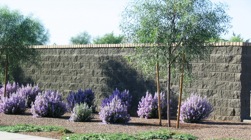
Not at all. Proto II™ uses standard cmu per ASTM C 90 in smooth, split face, and slumped textures, and may be stuccoed. It can be used with columns, pilasters, relief designs, and decorative capping. Virtually any design scheme can accept Proto II™ as all or part of the wall. Remember, the real difference is inside: engineering, installation methods, cost, and performance. Completed walls appear as any quality cmu wall. See Aesthetic Design. Back to Top
Are caps more likely to loosen on Proto II™ walls?
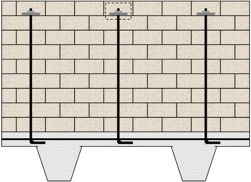
No. Capping methods are no different than conventional. Where a conventional wall typically has a bond beam in the top course or one course down, Proto II™ typically has a tensioning point at the top of the wall or one course down. In either case, the cap installation itself is the same, and mortar bond is the primary factor. Back to Top
Is it more difficult to get approvals/permits for Proto II™ vs. conventional?
No. Extensive engineering, established field experience, absence of any system failures, and passing a multitude of tests and critiques has earned Proto II™ Wall Systems broad based acceptance by building and safety departments. Jurisdictional approvals exceed 120. Many have given Proto II™ Standard Plan status, including the City of Los Angeles (Standard Plan #520). Back to Top
Who is responsible for the engineering used in Proto II™?
Proto II™ Wall Systems provides all engineering. This provides single-source reliability and accountability. Included is the Proto II™ Product Data Sheet and wet sealed engineering calculations. Custom engineering as required by site conditions is also available. Back to Top